Bradenton's Best Bat Removal
We've been voted Bradenton's best bat removal company the past two years!
Get in touch
Bat Experts
Rapid Response
Trained & Educated
Licensed & Certified
About Bradenton Bat Removal
Welcome to bradentonbatremoval.com. We are the only qualified bat removal company in Bradenton, Florida. Nobody likes to have to find they have pest animals in their home, and even the idea of it can be a real frustration to many people. While there are some animal issues that can be handled by yourself, a bat infestation is really a specialized job and requires a particular set of skills to get rid of the animals efficiently and without causing further problems around the home. One of our principles when dealing with a bat problem is that we will never use poisons, not only are they harmful and dangerous but they are also far less efficient as a solution than using exclusion which will get rid of all the bats without harming a single one. If you have any doubts, then we have plenty of reviews from satisfied customers, including those who have had bats removed from their property by our technicians. Taking time to examine the attic or loft space where they are present is the most important step, as bats can squeeze through holes that are as small as a quarter, and our technicians will find all of these access points. Most of these will then be repaired and sealed, with exclusion netting being installed over the last one or two holes that will allow the bats out, but stop them from returning into the property. This will quickly get rid of the bats, and we can then also help with cleaning and removing any damaged or soiled insulation, as well as disinfecting the area so it removes any residual risk of disease transmission. We operate 24-7-365, so don't hesitate to call us at 941-999-2893 to discuss your bat problem and schedule a fast appointment.
Residential
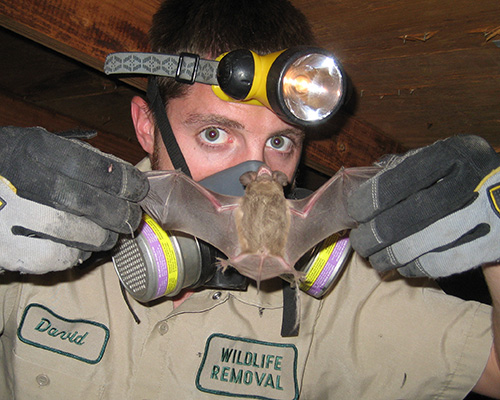
We are experts at removing bats from residential properties. Whether you have a single bat trapped in your house, a colony roosting in your attic, and/or various other problems, there is no need to worry! During our removal process, we make sure to inspect your entire home carefully, tracking down all the entrypoints bats are using to invade your place. Next, we perform a process called live exclusion (where no bats are harmed and all exit your property), then seal all entry holes completely shut. We also take care of the cleanup process after, so your home is safe and clean!
Learn MoreCommercial
Besides residential areas, we also have a wealth of experience removing bats from commercial properties! We begin by investigating the area for possible bat entrances, covering holes even as small as 1/4 of an inch. Through our live exclusion process, bats leave the building through one-way exits, and we seal up every hole afterward. Once the bats have been removed, we perform a cleanup process. This includes dealing with guano, replacing damaged insulation, and decontaminating the place.
Learn More
Contact us for bat removal today!
What Our Customers Say
I had a bat flying around in my house at 9pm, and CITY bat removal came right out and caught it in a net.
Sarah Lakewood
I had an annoying colony of bats stuck in my attic for a while before I finally decided to call for help. They were able to quickly and thoroughly solve the problem!
Brandon Chung
They did a great job clearing my attic of bats and didn't hurt any of the creatures.
Charlotte Demers
The technicians at CITY Bat Removal are skilled, professional, and know exactly what they're doing. Would highly recommend.
Mark O'Connor
My house stank of bats and their guano inside my wall. CITY Bat Removal not only removed the bats, they also got rid of the smell!
Alexis Ramirez
.jpg)
Are Bats Blind?
Superstitions about bats have led to wild accusations and inaccurate information available to the public. Of over 1,300 species of bats known, only three of them drink blood. The rest hunt insects, eat fruit, catch small fish, or drink nectar from flowers for their nutrients. These flying creatures' daily activities happen at night when we humans have poor eyesight. The way bats fly seems erratic and clumsy to us. As a result, we have assumed that their eyesight is terrible to non-existent. Scientists have proven that bats are not blind.
No, They Can See
With so many studies out there to explore the fascinating world of bats, from identifying so many varieties, their sources of food, and many of their habits, it is a wonder we still ask if they are blind. Bats are nocturnal creatures. Many have keener eyesight than humans to interact with their world. From interacting with each other, watching out for predators, and general navigation across landscapes, bats use their vision just as much, and sometimes more than, they rely on echolocation.
What Is Vision?
Vision is made up of two different photoreceptors in our eyes. Knowing that can help us understand how bats use their eyes in unison with their other senses to get around. There are cones and rods. Cones are used during daylight and to see color while rods are used during nighttime. This is partly due to the wavelengths of color that each one can process. New discoveries have determined that bats can see during the day, meaning they do have cones and rods, although they are poorly developed.
What Is Echolocation?
Echolocation is a sound-based method of navigation. Soundwaves are sent out and the echoes bounce back to the source. This information provides the distance between the source and the object. As a comparison, submarines are man's attempt to utilize echolocation. The way bats use this is by creating a high-pitched squeaking or clicking and listening for the echoes. The higher the pitch, the faster the sound moves, and humans cannot generally hear the sounds bats use for echolocation. Their sense of hearing is also heightened to accommodate the higher-pitched sounds they need to make. Scientists have suggested that bats developed this skill as an aid to navigating instead of a replacement for poor vision. Studies have supported this theory as we explore further into bat species across the globe.
Bat Vision
Although most active at night, some bats do move about during the day. One study determined that echolocation is primarily used at nighttime, although some species continue making their sounds during daylight flying. That study also found that bats speed up their echolocation when coming to land from flight. That information suggested that they use their visual and audible senses to give a more accurate gauge of distance.
Their vision is designed for low-light situations. These flying mammals take advantage of all of their senses to find food. Echolocation in bats is only effective for around thirty-three to sixty-six feet and thus, many use eyesight to keep track of things outside of that range. Instead of bumbling around like blind men, their erratic flight pattern is helpful in hunting and protection. It is a showcase of the combination of eating on the go and keeping away from predators. More often, bats rely more on their eyesight than echolocation in situations where they cannot use both.
Some Species Have No Echolocation
Certain species of frugivores never develop the ability to echolocate. Instead, they have extremely sharp vision with receptors that make it easier to see during the daytime. There are some that have developed the ability to see color as well as ultraviolet light. Being able to see wavelengths of light outside of the human visual spectrum has its advantages. Certain flowers reflect UV light.
Natural Mutations
Nature is unpredictable. Because it is difficult to document cases of any creature having an abnormality in their senses, most scientists thought that bats born blind or with ocular defects were either killed by predators or died from lack of hunting ability.
Recently, that theory has been disproven. At least four bats that have been caught in human-built locations were either partially blind or completely blind. This discovery made it clear that with the extrasensory ability of echolocation and natural development, bats can survive without their eyesight.